



 🖨️ Print post
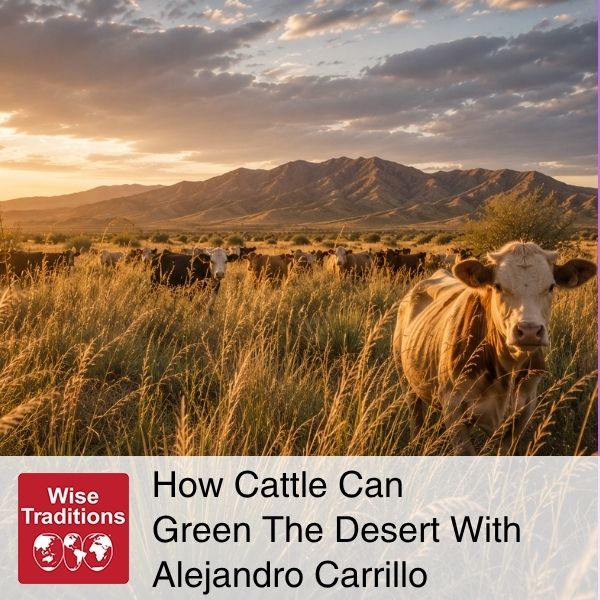
What if cattle could help restore degraded land, increase biodiversity, improve water cycles, and even produce more nutrient-dense food?
This week, regenerative rancher Alejandro Carrillo joins us from the Chihuahuan Desert of northern Mexico to explain how holistic grazing transformed his family’s ranch from bare, compacted ground into thriving grasslands teeming with life. Alejandro describes the surprisingly simple management changes that allowed nature to begin healing itself—and why he believes many of the world’s degraded landscapes can recover as well.
Alejandro explains how healthy soil functions like a sponge, why weeds are often nature’s first responders, and how carefully managed herds can improve water infiltration, increase plant diversity, and support wildlife ranging from migratory birds to predators. He also shares fascinating research suggesting that regenerative grazing may produce exceptionally nutrient-dense beef rich in beneficial compounds rarely measured in conventional food analyses.
Along the way, we discuss the importance of working with nature rather than fighting it, how regenerative ranching can help ranchers remain profitable while improving the land, and why Alejandro believes this approach offers hope not only for farmers and ranchers, but for anyone concerned about the future of our food, our health, and the environment.
WAPF Ad – Spanish-language resources from the Weston A. Price Foundation – Visit westonaprice.org and click on “WAPF en Español” and be sure to check out our Spanish-language podcast Tradiciones Sabias
Visit Alejandro Carrillo’s website to learn more – https://www.desertgrasslands.com
Join the Nourishing Our Children closed Facebook group
Check out our sponsors: Nutrition Therapy Institute – “Podcast listeners get 50% off their first course – that’s $475 in savings.”
Goddess Vitality by Optimal Carnivore – “Use code WESTON10 for 10% off”
—
Watch the episode here
Listen to the podcast here
Episode Transcript
Within the below transcript the bolded text is Kendall Nelson
Introduction To Regenerative Ranching
Across much of the world, we hear a similar story. Our soils are depleted, our water is disappearing, biodiversity is declining, and the future of food production feels increasingly uncertain. We’re often told that cattle are part of the problem, that raising animals damages the land and contributes to environmental decline. What if the opposite could also be true? What if, when managed in harmony with nature, livestock could help restore ecosystems, rebuild topsoil, improve water cycles, support wildlife, and produce extraordinarily nutrient-dense food?
This is episode 590, and our guest is Alejandro Carrillo. Alejandro is a 4th-generation rancher and the Founder of the Grasslands Regeneration Project on Las Damas Ranch in Mexico’s Chihuahuan Desert. After earning degrees in computer science and technical management, and working for years as an IT consultant in the financial sector, he returned to his family’s ranch in 2004 to help his father with the cattle operation.
What he found was a landscape in decline, compacted soils, bare ground, dwindling grasslands, and a ranch struggling to survive. Determined to find a different path, Alejandro began studying holistic management and regenerative grazing principles. His ranch has become one of the world’s most celebrated examples of ecological restoration in a brittle, low-rainfall environment.
In this episode, Alejandro shares how conventional grazing practices contributed to desertification and why he believes the way we manage animals, not the animals themselves, is often the real issue. He explains how strategically moving cattle can mimic the natural migration patterns of bison and antelope, restoring the biological processes that healthy grasslands depend upon.
We discuss the surprising role of weeds in healing damaged landscapes, why biodiversity is one of the most important indicators of ecosystem resilience, and how healthier soils can improve water infiltration and even influence local rainfall patterns. Alejandro also describes the remarkable transformation he has witnessed firsthand, native grasslands returning to land that once appeared barren, migratory birds finding refuge once again, and cattle thriving without the costly inputs many ranchers have come to depend upon.
He shares fascinating new research suggesting that beef raised on diverse desert grasslands can contain significantly higher levels of phytonutrients than conventionally raised meat, raising important questions about the relationship between ecosystem health and human nutrition. Perhaps most importantly, Alejandro offers a message of hope. He reminds us that degradation is not inevitable, that nature possesses an extraordinary capacity to heal when we work with her rather than against her, and that by restoring our relationship with the land, we can nourish not only ourselves, but future generations as well.
Before we get into the conversation, I want to tell you about our Spanish language resources from the Weston A. Price Foundation. We offer educational pamphlets in Spanish, an Instagram account @WestonAPrice_Espanol, and our Spanish language show, Tradiciones Sabias, hosted by Annette and Alberto. Visit The Weston A. Price Foundation and click on WAPF en Español to explore these resources. Be sure to share your favorites with your Spanish-speaking friends and family. Let’s welcome Alejandro Carrillo.
‐‐‐
Alejandro, welcome to the show.
Thanks for inviting me to your show.
I know you’ve been on the Spanish-language show for Weston Price, so I’m so happy that you’re here for the English version.
I am always excited to share what we have learned so far on the green in the desert.
I want to take a giant step backwards, and I want to ask you a little bit about your childhood. I was on your website, and I saw the most endearing photograph of you. You were standing in your black cowboy hat. You look like you were about five years old. You were with your grandfather and your father. It looks like you’re on ranch lands. Can you tell me a little bit about your childhood, where you grew up, and what it was like?
I’m a 4th-generation rancher. My great-granddad, my granddad, and my dad were ranchers. The original ranch was lost by my grandpa, so my father went to work when he was fourteen years old at a bank. He always had that dream about getting back into ranching, so he bought a ranch many years ago. That’s the ranch I started going to.
I tell people I like ranching because I watch too many Western movies. It was very traditional at that time. You ride all day. You do all these roundups and branding. It was fun to be part of the cowboy crew. I also love nature. When I asked my dad if I should study something related to ranching, like animal science or something, he told me, “Study whatever you want, but nothing related to ranching.” At that time, when I was going to college, I got my degree in Computer Science. I spent fifteen years working as an IT engineer consultant, and then my dad asked me to help him when he turned 70. That’s when I went back to the ranch.
Tell me a little bit about where the ranch is located. I’m interested in the Chihuahuan Desert. Can you paint me a picture of what the landscape looks like there? What kind of operations people operate on before they get into holistic ranch management?
Defining The Chihuahuan Desert Landscape
The Chihuahuan Desert is the largest desert in North America. It goes through three states in the US and four states in Mexico. Our cattle ranch is nested in the Chihuahuan Desert. It’s an area that gets about nine inches of rain per year. It’s called the Chihuahuan Desert, but historically, I have read evidence that when the Spanish priests came, it was all about tall grasslands. For us, it’s always very important when we go to a place to know the historical and ecological evidence because we take it for granted that it’s a desert.
It’s quite degraded. It may be similar to Utah, Nevada, and some other parts of New Mexico and the Western US. There’s a lot of bare ground, a lot of thorny plants, and not much productivity. I’m trying to define it to you so you have a little bit of vision. There’s a lot of cactus and poison plants, and not much life in general.
If I understand right, you’re talking about the 1600s or so when the Spanish came through. Was it the Spanish priests at first? They were documenting what they were seeing, and they were seeing these beautiful, lush grasses and ranch lands. Did they have a lot of animal diversity at that time, too?
This is hard to believe, but Chihuahua is a Northern state. It’s the largest state in Mexico. It borders Texas and New Mexico. We’re not that far from the border. We’re only 100 miles from the border, from the Rio Grande River. It was in the 1600s when they went through what we call the Camino Real, which connected Mexico City to Santa Fe. One of the alternate routes was near my ranch to get to Santa Fe for the transaction of a lot of stuff.
It’s hard to believe that almost whatever you find in Canada or even Alaska, we have the same wildlife. We still have mule deer, bighorn, pronghorn or antelope, and black bears. We have lost the grizzly bears. We used to have an endemic grizzly bear. It was an incredible place. Imagine if you have a grizzly bear, how much water and how much life you have to support such a big animal.
You returned in 2004 or something like that. What did you come home to? What did you find when you came back to the ranch?
Usually, when I’m putting on some kind of class or job education, I tell ranchers that we cannot stand still in the same spot because we are dealing with life. Life is in a continuous movement, so you are regenerating or degrading. Unfortunately, when my dad bought the ranch, we did not know any better than the very conventional ways, and we degraded the land pretty badly.
We cannot stand still in the same spot because we are dealing with life. Life is in a continuous movement, so you are regenerating or degrading.
I have the original pictures from when we bought it. It was decent grasslands, maybe not thriving grasslands, but when I joined the ranch, it was pretty much bare ground. It had a little bit of grass, but the grass was in very poor shape. We define the grasses in three colors, which are green, gray, and gold. As we want to promote life, we want to go into the gold and green colors, or green and yellow.
When you don’t graze a grass, when there are no animals to eat that grass, that grass starts decaying, dying, and it becomes gray. Gray grass doesn’t help anybody. It doesn’t hit the micro herd, which is microbiology. It doesn’t help the plants, the wildlife, or the livestock. When I joined the ranch, it was gray and bare ground. The grasses were gray, like a lack of grazing, and also a lot of bare ground.
You said that you guys take some responsibility for the fact that the ranch was becoming degraded. What practice was the conventional practice? What were you doing in the past that wasn’t so healthy for the land?
Our ranch is a 30,000-acre ranch with hills, flats, or grasslands, and a mountain range. We used to have only eight pastures. Imagine 30,000 divided by 8. There were big pastures, and then there were cattle everywhere, spread all over the place. We call it continuous grazing. You never graze any pasture because you have animals all over the place. When the grass is starting to recover, the cattle, sheep, or whatever graze it again. It keeps grazing until that grass dies.
That’s one side of the equation. The other side is that the cows also ignore other grasses. Eventually, the grasses that get over-grazed and the grasses that don’t get grazed at all both die eventually. Every day, you start getting more bare ground. At that point, people thought, “It doesn’t rain anymore.” This is a slow process where you’re degrading the land, and then you blame something else. You usually never blame the way you manage, which is the core problem that we have. It’s not the cow, sheep, donkeys, or horses. It is how you manage those animals. The way we manage animals is by always trying to mimic nature.
On your website, when I was looking at pictures, I would see pictures from before. The land was completely degraded. I would then see pictures of afterwards, where you’d be standing in these lush, beautiful grasses with the cattle feeding. It brings back a picture to my mind of Dorothea Lange’s images of the Dust Bowl. I think of it as this area where the water is not saturating into the ground, and therefore it’s dusty and dry. Can you explain a little bit about what the ground is like in those kinds of conditions?
Most of the Chihuahuan Desert still has compacted soils. To me, it’s a way for nature to protect the remaining seed bank that is still there. It builds like a layer on top of a layer, like a crust, where the rain doesn’t get in, and the wind doesn’t blow it up, but the seed tank is still there. Those are the conditions that we have seen.
I was in Colombia, South America. Usually, I ask a question to ranchers, producers, and in general, saying, “What is the major limitation on grass productivity?” It’s not rain. It’s air in the soil. The lack of air is what’s killing us. Many people think, “Do we need air in the soil? We can do it mechanically.” We don’t do it mechanically. We do it biologically. We do it through this aggregation, this micro-risal fungi. How can you put some air in the soil? You bring the biology through the cow, the gut, the manure, the saliva, and the urine. That’s how you change the whole situation.

The Biology Of Soil Healing And Water Infiltration
Am I correct in understanding that if you have air in the soil, then when it rains, the water will get captured underneath ground, and then that will feed the roots of weeds, and then that becomes something else? Describe the process. Once you can get some air into the soil and get the water in there, then how does the ranch progress into being these beautiful tall grasses?
Let’s keep in mind that we start in most of the places on my ranch with bare ground. I’m going to be using cows, but it could be pretty much horses, donkeys, sheep, or goats. When you use the cow, the cow has multiple tools to help you. Even if you’re passing by, like herding or driving, it has the hoof action. It breaks that hard pan. When it breaks that hard pan, it also puts manure, urine, and if there are some plants, the saliva also has microbiology. It puts all that microbiology into the soil.
Nature has an army of healers, which are the weeds. The weeds with the taproot system go, and they’re going to go deeper. With that taproot, they’re going to go deep, opening the soil and extracting all those minerals. The seed tank may not be that deep. We’re putting a lot of carbon. Weeds put in a lot more carbon than grasses. We need to know and respect natural succession.
I tell ranchers, if you do a more cattle impact, where you try to mimic those bison herds with an electric fence, the first thing you’re going to do is not expect to see perennial grasses. You’re going to see a bunch of weeds because nature is going to send you exactly what you need at that point with that kind of soil, with that kind of conditions, everything is.
I tell ranchers, “The day we understand or recognize that nature is trying to help us, it’s going to change the way we see things.” What we’re trying to do for the ranchers is to see things differently. When you make an animal impact or herd impact on bare ground, then you’re going to wake up all the seed bank, but all the seed bank first from the weeds. We respect that phase. Let’s say next year, you have average rainfall or a little bit less rainfall. You’re going to start infiltrating more water because you already put carbon in the soil. Where is the carbon coming from? It’s the taproot of those weeds.
You’re going to start seeing some annual grasses, maybe small ones, or maybe not that small ones, and then a little bit larger, and then a mix of weeds, annual grasses, and perennial grasses. Your goal should be to move from bare ground to weeds, to annuals, to perennials. The latest of the rewards will be forbs. Forbs are these flowering broad-leaved plants that will give you a full spectrum of colors in your grasslands.
The last time that I was at a presentation from Christine Jones, a soil scientist from Australia, she said that North America’s grasslands were forb plants. If we reach for 100 grasses, you’re talking about probably 400 forbs. Why don’t we see the forbs? It’s because forbs, which are potable herbs, need a better water cycle. It’s when you create these thick, beautiful perennial grasslands that you start seeing these beautiful forbs, as we call them in the US.
You mentioned 100 grasses. Is that something that every rancher should be striving for? Is that the golden number? Tell me a little bit about that.
When I travel, I like to see the books of the plants that are supposed to be there. I’m more focused on grasses and forbs. We are supposed to have more than 100 different grasses. Even in Australia, they have almost the same number of different grasses as North America. Forbs would be 200. In my ranch, we’ve been working with bird conservancy organizations of the US, such as Audubon, American Bird Conservancy, Bird Conservancy of the Rockies, and the Nature Conservancy. They go to my ranch and do transects every year. They walk virtually on a line and then count the birds.
We got the birds from Southern Canada and Northern US, and they go and migrate to all grasslands and pass the winter there, or at least seven months. They spend a lot of time there. They not only count the birds, but sometimes, they also get some plants. A couple of years ago, we got 25 different grasses. A few years ago, we already reached 80 different grasses.
Why is it so important for the rancher to strive for many grasses? You cannot manage what you see. Your management needs to promote diversity. If whatever grazing management you’re using is promoting diversity of plants, insects, birds, and wildlife, diversity equals resilience and also extends the green season. When we started at the ranch, the perennial grasses were so sick and struggling to survive that they were only green for three months.
What is the problem when we have these struggling perennial shallow-root-system grasses? Are we expecting as ranchers to get rain every day? It won’t happen in the whole Western US, Australia, Northern Mexico, and many places in the world. We need to work to get these perennial grasses healthy with a very deep root system so we can be more resilient.
Remember something. The root system will not only go where the moisture is. It will go where the moisture and air are. That’s why you go to many corn fields, and then you get a shovel and look at the root system. The root system goes sideways because of the tilling, the chemicals, and the compaction layer. The air and soil are so shallow that our corn fields, if they face a strong wind, fall. The corn is, at the end of the day, grass. Extending the green season is such a critical component because, first, you need a green plant to feed the microherd, the microbiology.
Second, if we ranchers want to survive only with what the ranch has to offer, we have to have something green year-round. We’ve been able to extend the green season from 3 or 4 months to 12 months. The only thing we provide to our cows is sea salt. That makes us very resilient. We’re not worried if the area went up. Not anymore. It’s a process, I understand. You will not achieve it, but you have to strive to extend the green season and also promote more diversity, raising the bar.
Nutrient Density And The Flavor Of Regenerative Beef
With this diversity, especially of the grasses, does that affect the meat of your cattle? Does it make them healthier to consume?
That’s a very timely comment because I sent a sample of my beef to the University of Utah. I sent it to Stefan Van Vliet, who has done some nice research on meat. They compared my beef versus the average grass-fed and average conventional beef in the US. We started getting these crazy results. The phytonutrients and flavonoids, some of them, were through the roof. It was twenty times more. I asked Stephan, “What’s going on?” The B complex was great. The Omegas were 1:1. It was amazing. The phytonutrients were amazing.
I asked, “Stephan, what’s going on here?” He said, “Since you’re in a desert, the desert plants are very resilient to everything that you throw at them, like water. They don’t want to be eaten. They want to be protected.” I didn’t know this, and I’m not sure if you know this. Out of 100% of all the nutrients in meat, what we know is only 2%. Proteins, fats, minerals, and vitamins only represent 2%. The other 98% is the study that Utah is doing. Those studies are amazing. We were surprised by how nutrient-dense our beef is in a ranch that is practicing regen ranching or holistic management in the desert.
I’m going to have to come visit you to get my beef instead of buying it in the grocery store.
It is amazing. Beef is not even considered to be a supply of that kind of beta-carotene, but ours was 56 times higher than that of grass-fed. It’s amazing. We’re pretty happy with the results because that closed the whole thing. We are recognized for making ranchers more profitable to increase the carrying capacity of the number of animals by 3 or 4 times to promote wildlife.
We have a motion tracking station that was put there by the bird guys. They track birds with a device. Our ranch is getting the largest number of endangered and listed migratory birds south of the border. I was so happy with those results. Due to the long battle, we had with the conservationists, we know what works for the cows or for the birds. The bird is a great indicator for us of a healthy ecosystem.
It’s more profitability, better temperatures, and more infiltration. Water is becoming a big issue in many places. Also, the nutrient density is amazing. I was expecting not such great results, but I was expecting something good. Remember that the fatty nutrients are also called flavonoids. Our beef has a flavor. I believe, but don’t take my word for this, that beef has to have a flavor. If it does have nutrient density, it has to have some flavor because it’s the flavor of all the plants. In the desert, we have a lot of aromatic plants.
We’ve talked a lot about how the ranch was degraded and how you came to the ranch. What process did you go through in order to rehabilitate the land?
Holistic Management: Moving Cattle To Mimic Nature
I was curious to try something different. I knew the suffering of being dependent on the income of the ranch. That was a different challenge than when I got my job. I was very blessed because the best holistic management practitioners in Mexico were in Chihuahua, where we ranch. They gave me a class, and then they became my friends. Having my instructors as friends and mentors completely changed the whole thing. They were men of faith. You need to have faith to see such a degraded, depressed place and believe that you can move that place to something that will not take life away from you, but will give years of life to you.
You need to have faith to see such a degraded, depressed place and believe that you can move that place to something that will not take life away from you, but will give years of life to you.
I imagine that moving the cattle in a certain way is very important to holistic ranch management. Can you explain the difference between what you do and what maybe some neighbors do that are not doing things with holistic ranch management?
I can explain to you our evolution. We used to have eight pastures of cattle all over the place. The approach was, first of all, you need to have more control of the cattle, mimicking nature. In nature, animals don’t spread out because they could become prey. Their protection is the herd. You also need to think about making enough animal impact.
We moved from eight pastures, eventually in 10 years, to 350 pastures. We started using electric fences because it’s more affordable. Otherwise, we wouldn’t be able to do that. Those 350 electric one-wire fences can be split again with poly wire, like with the portable electric fence. In a good rainy year, we could go up to 1,000 paddocks.
We start moving every other week. Once we start adding more paddocks, we move once a week. We move once a day, or sometimes even twice a day. We give them time to ruminate, explore, rest, and everything, but every day, between 9:00 and 10:00 AM, we call them. Remember, you play two roles. You play the role of the herder or pastoralist, and then you also play the role of predator. You are also always calling cows that are struggling, so you keep that herd clean.
It’s been helping us a lot also with the predators. Remember, if I’m growing more grass and more food, then there will be more deer, more wild pigs, but also more mountain lions and more coyotes. It is the herd that is helping us not to have a fight with the predators. Everything in the ranch has a reason for being there.
We have to take the approach of not fighting anything. That has always been a problem with a lot of us ranchers. It’s like, “I don’t like this. I don’t like that.” We spend a lot of time being like, “I have to kill this. I have to kill that because it’s encroaching on me.” The beautiful thing about this is that we are at peace with all the creatures, including the insects and everything. We feel that with everything. There’s a reason for that to be there.
Talk to me a little bit more about working with nature and how important it is.
For us, nature gives us plenty of abundance. I don’t think we have even reached the surface of this. It’s very amazing. We are growing because we haven’t seeded anything. We haven’t done any mechanical things. We are not irrigating anything. Let’s say we got twelve inches of rain. We were in drought mode again because our soils were compacted. If we get six inches per year, we can grow a lot of grass, and then we can keep all the cattle with no problem.
We’re trying to keep a reserve of grasses, which we call stockpiling grasses, for at least a year and a half. We’re not rushing into getting that nice green up. We keep moving every day. We will get to the same pasture in about 14 to 18 months. It’s important for you to have this mosaic of a lot of grass here and not much grass here for the different wildlife. The goal at the end of the day is to promote life in all shapes and forms and to try to get as close as possible to nature.
Now that you’re talking about nature, why are we trying to do everything with cows if nature has multiple different animals to do things? A couple of years ago, we added donkeys to the herd. We have only one herd, but we have the mares, saddle horses, and all the cattle. Also, we’re running 30 donkeys with the cattle.
Many people believe that I have donkeys for protection. They may provide some protection, but it’s because we are grazing much better with donkeys, because donkeys are always looking for these rough stems and things like that. The cattle don’t thrive on that. Sheep and cattle are more selective. They need more leafy stuff. The donkeys help us do more grazing without forcing any of our animals to eat what they are not supposed to eat.
You’re not just a rancher, but you’re a teacher. You go around and lecture. You’ve been to all kinds of places around the world. How difficult is it to get people to change? I imagine the people who come to your lectures want to change, and they’re ready. What about people in the Chihuahuan desert who may not be right next to your ranch? They’re not seeing the benefits of your ranch. If you went to them, is there any apprehension in making these changes because it’s been done one way for so long?
We have learned to set the expectations more to what happens. It depends on where you go. There are some places where they start getting more traction, and I can explain to you why. We’re always looking for these few folks that we will pass the torch to. They will be the champions of that area. That’s what we’re looking for. It’s not that we select them.
I can give you a lot of examples in the US, like Montana, New Mexico, and Oregon. We have a few guys who are doing nice things. They need to keep things going. We cannot go all over the place. My goal is to pass the torch, to provide them with the tools and education. I usually give them some homework at the end of the workshop, like, “Let’s do this trial. I don’t want you to develop the water. I want you to find a good spot.”
When I went to Australia, there were two guys between 20 and 40. They showed me the pictures. They were like, “I did my homework. Look at it.” You can see the darker green on the fence versus the light green. There was a young fellow in Western Australia who used sheep, and it was fair ground. They have a large number of sheep together. This guy probably has 5,000 sheep. It was greening up, or there was nothing. That’s when you get very excited.
Expecting all people to change with the class, it’s more like awareness. One big advantage that we have is that we have something on the ground. We are talking rancher to rancher. They try to test you to see, “Let’s see if this guy knows.” We’ve been there, done that. We are ranchers. We’re talking rancher to rancher. That builds a lot of confidence.
Also, another thing that builds a lot of confidence is that we are in a very low precipitation area. I was in Australia. A guy told me, “We only got 500 millimeters.” I told him, “What do you do with so much water?” He was like, “I was joking. I only have 200.” It’s hard for them not to do it because we’re in a very brittle environment. We have nice results, and that builds a lot of confidence and a lot of hope in people.
At the end of the day, what we bring to the ranch community is hope. First, it is to the ranch community, but also to the conservationists, because they also want ranches that thrive with life. I know it is also to the consumers because we can also provide an excellent product that is free of chemicals and very nutrient-dense.
You were mentioning the rain and laughing that you only got 200 millimeters of rain versus the 500 that they were getting in Australia. I read that your ranch, where you’re doing things right, gets more rain than a neighboring property that’s doing stuff wrong. Can you explain why? I have some understanding that maybe the microbes are making it rain, but I’m not sure. You need to teach me.
Creating Microclimates And Improving Water Cycles
Talking about the water cycle, on one side, you have the effective rainfall. Don’t tell me how much rain you get, but tell me how much rain you keep. If you go, for example, to many states, like Colorado, where they have done some tests, if we’re trading 20%, I’m being very conservative. Imagine 20%. If I’m in a 10-inch area, I’m only getting 3inches effectively.
The other thing is you can create a microclimate. Meaning, once you start establishing those thick grasslands, then you’re changing the temperature, the moisture, and the mist. Once the water cycle starts getting correct, like you have to add more water, it evaporates. Not only does it evaporate, but it also evapotranspires through the plants. That evapotranspiration has bacteria on it that will not only form the clouds, but it will also seed the clouds. That’s what we call the small water cycle.
We are, at the end of the day, responsible for about 40% of the rain we get because 60% is coming from the ocean. It is at 40% that we believe that we get about 10% to 20% additional rain. The good news is that I have two of my neighbors on board. We are getting that microclimate bigger and more resilient. Beautiful things happen. We don’t have the scientific data to prove it, but there are scientists who are studying those.
For example, Walter Chen from Australia explains the water cycles pretty well. I heard in one of my classes, I think I was in Nebraska, that there was a meteorologist. He told me that based on their studies, you need at least 10,000 acres of solid vegetation, which is about what we had at that time, which was 10,000 acres of solid grasslands, to start making a change in the microclimate. It will not affect where you are in your context, but it’s an indicator. We’re excited about what’s going on at the ranch on many fronts.
What do you see for the future of the ranch? What will get even better as time progresses? What do you see in ten years?
That’s a beautiful thing. We do expect to be a refuge for migratory birds. Unfortunately, the sparrows have declined 70% in the last couple of years. It’s critical. We still want to be a refuge, together with my neighbors, in a place where we can help them at least maintain. It will probably be very good for the wildlife in general.
We will provide better meat for our consumers because we’re in continuous improvement. My ranch has 500 cows. One very important part of these ranches is water. We’re getting water from wells. The wells are okay, but the pipe to distribute the water needs to get an upgrade because we are planning to go from 500 cows to 1,000 cows on the same acreage. That’s what’s beautiful about this. You can keep increasing your cattle in the same place.
We love to break paradigms. I tell people that if we have something like magic, saying, “All the ranchers in the Western US know how to do regen ranching or regenerative ranching,” the first problem we’re going to face will be that we don’t have enough cattle. That story about how there are too many cattle on the grass? There’s not enough. Under proper management, there’s not enough. We can increase by multiple times the number of cattle in the Western US in a sustainable and regenerative way.
The Future Of Beef And Restoring Ecological Health
If we did all of the regenerative ranching and turned these deserts or dry lands into beautiful ranch lands, and we put more cattle on them, and we’re able to sustain it, is it possible to feed the world beef? We hear a lot of criticisms that the cattle do all of these bad things and that there isn’t enough to feed everybody. What are your thoughts for the future?
I don’t disagree, for example, with the conservationists who are saying, “We need to fence this out. We need to get rid of these cows.” I agree with them if you are managing it conventionally, like doing continuous grazing. You need to keep moving them. To answer your question, I have no doubt that beef or meat is a crucial food for us as humans to develop everything for our health and longevity. We can do it based on grasses and plants.
At the same time, the majority of the wildlife disappearing is because of habitat loss. It’s not because of hunting. I mean inland. I cannot say anything about the oceans or the sea. Inland is experiencing habitat loss, and that has a lot to do with cows managed in a conventional way. Think about this. In Southern Mexico, which has more dry tropics, 80% of the feed that is being given to cows is coming from outside of the ranch. We are opening a lot of areas for farming that are not to feed us. There’s a domino effect. It’s a terrible effect that is happening in cattle ranching. The more you degrade your land, the less money you’re going to keep in your pockets, and the more you’re going to degrade more land beyond your boundaries.
Your story is so inspiring. I admire all of the work that you’re doing. I know that a lot of the world is covered in desert-type environments that could be rehabilitated and better feed not only us with the cattle, but also the wildlife, and that kind of stuff. As we begin to wrap up, I’d like to ask you this. Has this work changed you in any way as a person? I know you’ve been at it since 2004, being back on the ranch. What have you learned? How has it changed you?
Personal Transformation And A Message Of Hope
It was a big change. Since I graduated from IT or computer science, I spent some time in the corporate world. When I met my mentor, Jesus Almeida, he was so giving and community-driven. I couldn’t believe it. I was like, “Why? What’s going on here?” It does change you. Also, it makes you humbler. At the end of the day, we’ve been failing to dominate nature. We recognize that nature has the last word on everything. She’s driving everything. You have to be part of that nature and respect nature.
It has been a big change. Also, you recognize that you need more of your neighbors than the ranches. I’m so happy that out of my 4 neighbors, 2 of them are on board. Everybody is doing better. There are fewer critical problems. We’re talking about more exciting things. You need to build your community to advance because dealing with nature is not a simple business, but it’s also a very rewarding one.
If there’s one thing that you want the reader to take away from this talk that we’ve had, what would that one thing be?
We need to have faith and hope that we can reverse the trends in many areas. In a particular case, for example, in Mexico. A lot of these people are migrating to cities or getting into illegal business. We want to keep people on the land. We want people to thrive. There’s no better way to grow than on a ranch that is thriving with life.
I imagine it’s wonderful for our children as well to grow up on ranches. Thank you so much for being with me here. I know you’re going to be at the Weston A. Price Foundation Wise Traditions Conference, coming up in October 2025. I can’t wait to meet you in person and come and hear you speak.
Thank you. Thanks for your time and for the opportunity.
‐‐‐
Our guest was Alejandro Carrillo. To learn more about his work, explore the Grasslands Regeneration Project and discover how holistic management is transforming degraded landscapes into thriving ecosystems. Visit the Grasslands Regeneration Project. This conversation was a powerful reminder that the health of people, animals, and the land is deeply interconnected. We explored how conventional approaches to ranching can unintentionally contribute to desertification and declining biodiversity, and how working with nature, rather than attempting to dominate it, can restore abundance in even the harshest environments.
Alejandro showed us that cattle are not inherently the problem. When managed thoughtfully, they can become powerful tools for healing the land. He also challenged many of the assumptions we hold about food production. We discussed how healthy soils support healthy plants, how diverse grasslands nourish wildlife and strengthen water cycles, and how the nutrient density of the food we eat may be influenced by the vitality of the ecosystems from which it comes.
His story reminds us that resilience isn’t built through shortcuts or technological fixes alone, but through careful observation, humility, and a willingness to learn from nature’s wisdom. Perhaps most importantly, Alejandro offered a message of hope. At a time when headlines often focus on environmental decline and scarcity, he invites us to imagine a different future, one where degraded land can be restored, rural communities can thrive, wildlife can return, and farmers and ranchers can once again become stewards of abundance.
Healing is possible. Nature wants to recover. With patience, faith, and thoughtful management, we can transform entire landscapes. If you’re enjoying the show, we’d be grateful if you take a moment to leave a rating or review wherever you tune in. Your feedback helps others discover the show and become part of this growing community. Thank you for spending this time with us. Be well, be nourished, and be free.
About Alejandro Carrillo
Alejandro Carrillo is a fourth-generation rancher in the Chihuahuan desert. Rarely his precipitation goes beyond 9” per year (< 225mm). He is not willing to waste any water in such a brittle environment if he wants to graze year-round without inputs.
Alejandro’s ranch, Las Damas, has been part of multiple documentaries and studies focused on regenerative ranching and “greening the desert” using livestock such as Common Ground, Sacred Cow, To Which We Belong, and Water in Plain Sight. Alejandro’s Grasslands Regeneration Project company assists ranchers and organizations on regenerative grazing projects in the Americas, Europe, Africa, Australia, China, and the Middle East. He also participates as a delegate to the United Nations Convention to Combat Desertification. Before joining the ranch, Alejandro worked as a software engineer in multiple countries. He holds an MS in Technical Management from The Johns Hopkins University and a BS in Computer Science from the Monterrey Institute of Technology.
Important Links
- Grasslands Regeneration Project
- @WestonAPrice_Espanol on Instagram
- Tradiciones Sabias Podcast – The Weston A. Price Foundation
- WAPF en Espano
- Facebook Groups | Nourishing Our Children
Episode Sponsors
🖨️ Print post
I wish that buffalo were more of a larger part of conversations that talk about restoring land. The North American bison evolved on and with the land in North America. Look into it.